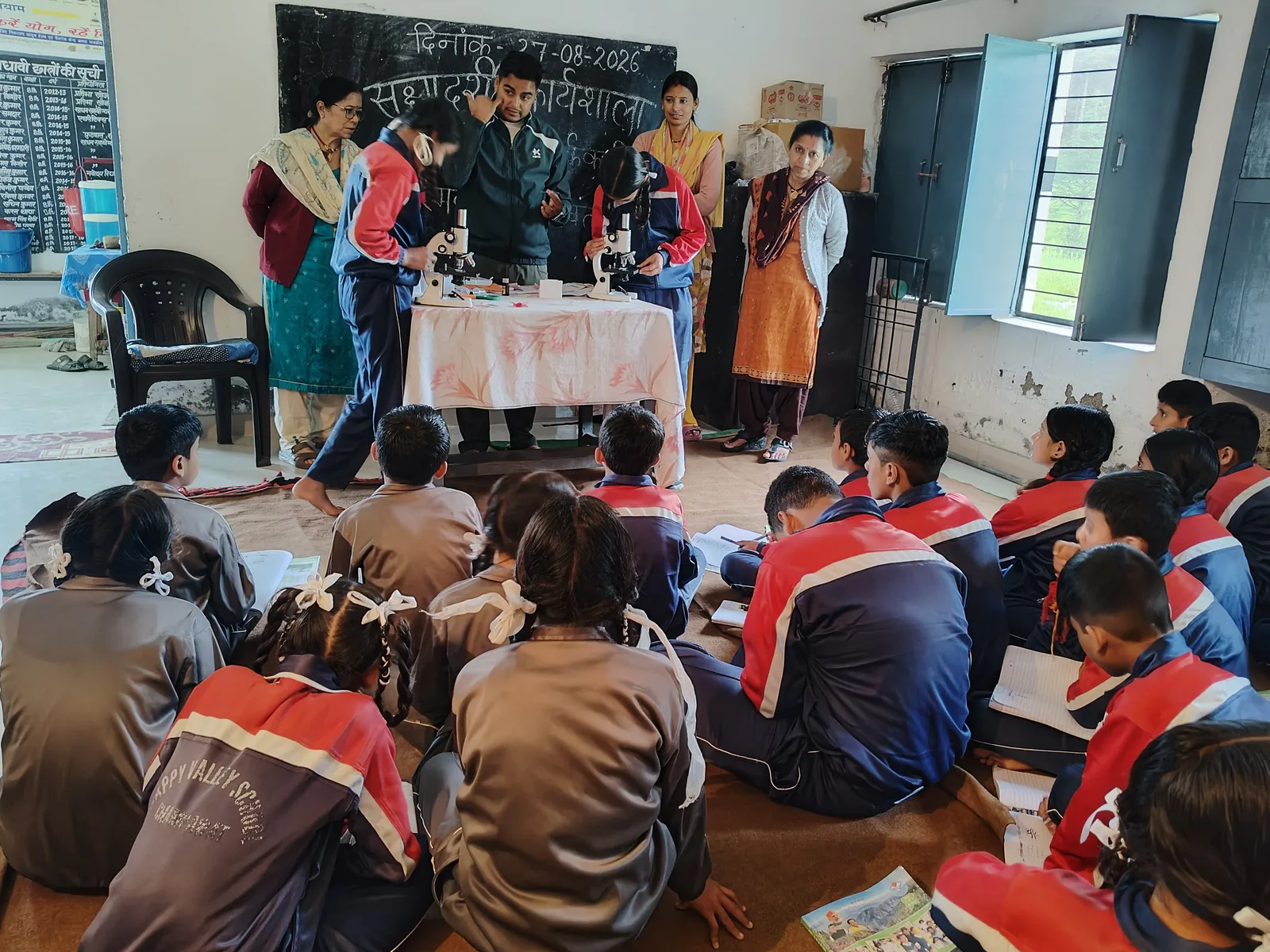
Under the society’s Science Outreach Programme 2026, a microscope workshop was held on 27 August at Government Upper Primary School Kharkkarki, in Champawat. The date and the subject were chalked up on the board at the front of the room, which is where the photographs on this page were taken.
The children were taken through mind mapping, shown how to use a hand lens, and introduced to micro-organisms. Five activities were run in all.
The five activities
The sheet the workshop worked from is photographed at the end of this page. It sets out:
- Observation with a hand lens. In groups of four or five, looking at a hair, a cotton thread, a grain of sand or soil, and an ant, each laid on white paper, and drawing what they saw.
- Observation under the microscope. The same objects again, this time mounted on a glass slide.
- Pollen grains. Shaking the dried stamens of a hibiscus flower onto a slide, then comparing the pollen of one flower with another.
- Onion-peel cells. Lifting the thin skin from a piece of onion, mounting it in a couple of drops of water, and adding iodine to bring out the cell walls.
- Micro-organisms. Prepared slides of amoeba, paramecium and euglena, and of plant and animal cells.
The sheet ends by asking the children to work out for themselves what the difference is between what a hand lens shows them and what a microscope shows them, and to draw their own conclusions.